
Species deep dive: Orca

It’s November 2022; I am working on board MS Fram as a marine biologist, and we are currently off the coast of South Georgia. The sun had just set, and we had finished our team meeting. Most guests were still at dinner, so I decided to use the time to go through the photos I had taken during the trip up to that point. I took a place along the long table in a public area with my back to the window, so I was still easily approachable by guests. I wasn’t the only one who had taken place here to work on photos or our lectures. It was getting dusk, and we were all quietly working when the radio went off. Our colleague practically shouted through the radio, ''Orca of starboard''. Instantly, chaos followed. Everyone jumped up and sprinted to the starboard windows. Through the window, I saw three big black fins go down; these fins could only be from orca. ''Oh, my gosh, my first ever orca''. Tears started welling up in my eyes. They went right underneath the boat, and my colleagues and I rushed up a deck to go outside on the port side, hoping to see them come up again. We all ran around the ship in search of these orcas. Where will they come up next? The fact that this happened at dusk did not help our search. And after more than 10 minutes walking around the ship. It was decided that they had disappeared. My first-ever wild orca encounter ended before I could even register that I had seen them in the wild.

The orca, also known as the killer whale, is the true apex predator of the ocean and is known for being an incredibly social and intelligent creature.
Most people know what this species looks like. They are very recognisable with their black-and-white bodies, white eyes, saddle patches, and, of course, their tall dorsal fins. Many people want to see them in the wild. I am no different; for the longest time, these animals eluded me, and even when I finally got to see them, it was more of a tease than a proper sighting. But what makes these animals so interesting? Why do we humans feel so connected to orcas? Well, I can't answer that for everyone, but I can definitely do so for myself. So join me as we dive into the fascinating world of orcas!
The social orca
The reason I really wanted to see orcas in the wild is not just because they are the top predators of the ocean, or that they are impressive-looking animals. It's also because of their strong family bonds. There is something inspiring in the strong connections they have with each other, and there is also something we can learn from these connections.
Orcas live in tight family groups called matrilines, which means they have a matriarch, aka a female who leads the group. Most of the time, the offspring of a Matriarch stay with each other for their entire lives, including the males. They hunt together, they socialise together, sleep together and play together. Males tend to leave their matriline to join other matrilines for a short time to mate and to prevent inbreeding. Often, after mating, males tend to return to their mother, as they really are mamma's boys. The gestation period lasts between 15 and 18 months.
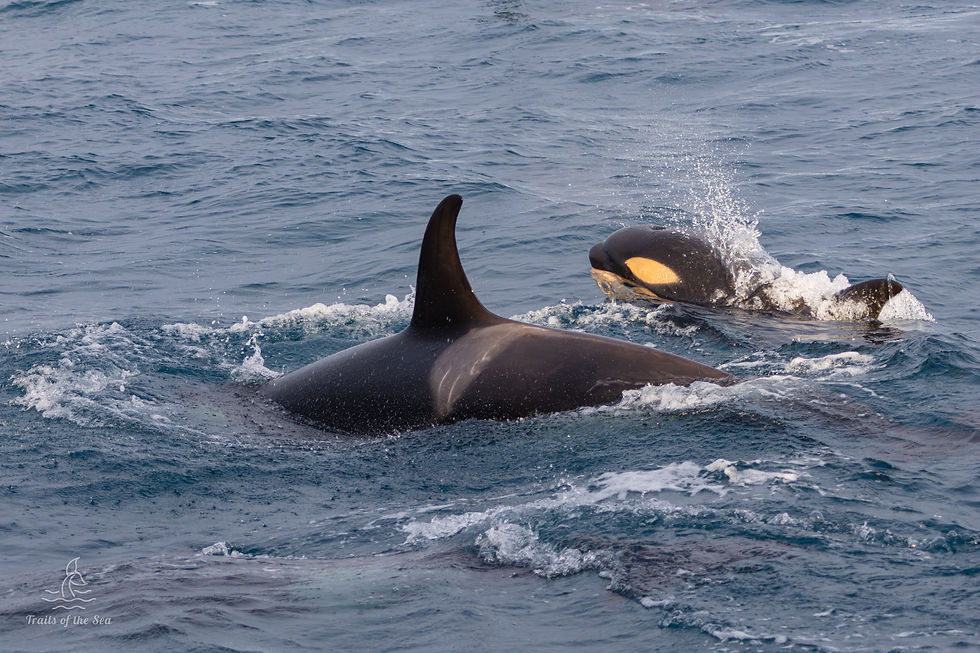
When a calf is born, it doesn’t have the white colouration just yet; what will later be white has now more of an orange colouration. Depending on the population of orcas, this colouration can remain for up to two years. In some populations, this is only up to one year. The calves lactate for up to two years, which requires a lot of energy from the mother, who often greatly increases her food intake. During this time, the calf will almost be glued to the mother; they will surface almost synchronised with the calf, just a fraction of a second behind the mother. Honestly, a newborn orca is one of the cutest things you can see; they are so tiny and adorable! But only 50% of the calves actually reach adulthood, as they are highly dependent on their mother and family. However, research has shown in populations of the Pacific coast of Canada that female orcas have fewer offspring if they have (many) sons or first have a son, as it takes more time and effort to raise a son than a daughter. Research in Canada has also shown that male orcas are likely to die sooner if their mother has passed away. More research is needed, though, to see if this is also the case in other orca populations. For example, here in Iceland, males have been observed swimming without their mother for quite a few years. Or take the two famous male pairs in both Scotland (John Coe & Aquarius) and in South Africa (Port & Starboard) who have both been living without any females for many years.

Male orcas might not be the best of fathers, seeing that they abandon the female they mate with, they are, however, great brothers and uncles to the juveniles in their own matriline. And can often be seen babysitting. If a matriarch has many daughters, her elder daughters often help raise their younger siblings. Young females reach sexual maturity earlier than males, at ages 12-13. Males at this age are just starting their growth spurt and developing their tall dorsal fin, which is how to distinguish an adult male orca from an adult female. The dorsal fin of a male orca can grow as tall as 2 meters. A male orca reaches sexual maturity between the ages of 15 and 20 years old, and they can live up to 40 years old. Whereas females live up to 60 years old or even 90 years old. Orcas are among the few other mammals on our planet that go through menopause, like us humans. Females tend to be sexually active for 25 to 30 years. At around ages 40/50, they will go through menopause and become incredibly important to the rest of the group, as they are then filled with the wisdom they have gathered throughout their lives.
The importance of grandmothers

It’s the wisdom of these older females that the orca family relies on; she knows where to go in hard times, and she can teach their specialised hunting techniques, dialects, and culture. She will remember where to go in hard times, and where and in which season there might be plenty of food. She remembers their migration routes. She will also be the best hunter of the group. Having an older female who has undergone menopause in the group also greatly increases the chance of calf survival, as at that point she doesn't have any young calves of her own and can focus on teaching and raising her daughter's younger calves. She helps her daughters give birth to their offspring. She will share her prey with the younger individuals. Prey sharing is something orcas do in general; all adults share their catches with juveniles. Sometimes a mother will even simply hold their catch in their mouth whilst the juveniles eat. The grandmother is also the teacher; a great example of this is found in the Patagonia population, which mostly hunts seals and sea lions. She might catch prey, making sure to wound it just enough that it can still swim. Then she releases the prey again and shows the young ones how to hunt, after which the young get to practise.

Something else that is really important in the world of orca is teamwork. We can see this really well here in Iceland when the orcas are hunting for herring. They use a special technique that has only been seen here in Iceland and in Norway. They approach a school of fish like herring. They separate a smaller group away from the main school of fish and herd them together in a tight ball. They do this by flashing their white bellies and blowing bubbles through their blowhole. Then one of them slaps its tail through the school of fish, which then stuns or kills the fish, after which the orcas pick up the fish one by one. In Iceland, they have even been heard using a special herding call that hits the fish's swim bladder. The swim bladder for fish is important to move up and down in the water column. When the swim bladder is immobilised, the fish can't move up or down anymore, which makes it even easier to pick up a fish. And with all these fish at the surface, you will often find many seabirds above the feeding frenzy.
Orca ecotypes
So orcas are phenomenal hunters; their prey list includes over 150 species, ranging from sharks, whales, and dolphins to seals, sea lions, turtles, seabirds, rays, and fish. It all depends on where in the world they are. Besides being the true apex predators, they are the most widespread mammals on the planet after us humans; they can be found in every ocean and most seas, from the tropics to the poles. After that first semi-encounter with orcas, it took me another two years before I got to see another orca in the wild, but this time it was in Norway, also in November and at dusk, which was at two in the afternoon. Two orcas passed the ship I was working on as a guest lecturer. These orcas would be completely different from the ones I had glimpsed off the coast of South Georgia.

This is because no two orca populations are the same; they differ in size, appearance, food preferences, hunting techniques, and language. Currently, there are 10 known ecotypes of orca, and within these ecotypes are different sub-populations. In the Southern Hemisphere around Antarctica, there are 5 ecotypes: Type A, B Large, B Small, C, and D. In the Northern Hemisphere in the Pacific, there are three ecotypes: Resident, Biggs (transient), and offshore. In the North Atlantic, there are two types: Type 1 and Type 2. Although there are still discussions as to how many ecotypes there really are. It could be way more than these 10. The North Atlantic region alone has at least six distinct populations of orca.
But what is an ecotype?
An ecotype is a distinct population with different behaviours, dialects and is genetically different from other populations. These populations have adapted to their ecosystem; over time, these ecotypes might evolve into different species, or they might already be distinct species, but scientists haven’t proven this yet. Take the current two Type B Antarctic orcas; they both live in the coastal waters of Antarctica, but the large one, also known as the Pack Ice Killer whale, is found circumpolar around Antarctica, and mostly in areas with lots of pack ice and floe ice, where they hunt for Weddell seals, but they may also hunt for Leopard seals and crabeater seals. However, they have also been seen hunting for the Antarctic minke whale. Whereas the small type B, also known as the Gerlache Killer whale, which is mostly found around the Antarctic Peninsula, mainly feeds on penguins and deep-sea Antarctic fish. Technically, they live in the same ecosystem and habitat, but they have adapted differently to this habitat. They have different prey and different hunting techniques. Another interesting aspect of these different ecotypes is that they don’t breed with other ecotypes, which keeps them genetically distinct. They also have different dialects, and different populations of orca might not be able to communicate with each other. Another difference between ecotypes are the hunting techniques. For example, there are more seal-eating ecotypes among orcas worldwide, but they all use different hunting techniques. The Type B large orcas hunt for seals on floe ice. You might have seen it on documentaries.

Where the orcas first spyhop next to the ice floe, spot the seal, swim away, then line up and swim synchronised underneath the ice, creating a wave that breaks the ice and pushes the seal off. It is an amazing spectacle to behold, and I, for one, would love to see this in the wild. But then there are the Patagonia orcas, who also feed on seals and sea lions. They, however, don’t have any ice floes on which a seal might rest. In Patagonia, the seals rest on beaches. So these orcas have developed an amazing technique where they purposely beach themselves to grab a seal. They have mastered the use of waves crashing on shore, and with great timing, they can grab the tail of a seal and drag it off the beach back into the sea. In Scotland, around Shetland, the orcas work together to chase a seal into a narrow bay and block the entrance by positioning a few orcas, whilst other orcas actively chase the seals to catch them.

In some regions, orcas eat only one specific type of prey, as in Northeast Pacific populations, so they are truly specialists. For example, you have the Bigg’s or Transients orcas on the west coast of America and Canada; they feed on marine mammals, including whales and dolphins. They haven’t been observed to eat fish at all, whereas the Offshore orcas in the same region only eat fish, including many shark species. And they haven’t been observed to eat any marine mammals at all. Furthermore, there is no evidence that these two populations interbreed or recognise each other, even though they can be found in the same habitat. This prey specialisation hasn’t been observed in this way within North Atlantic populations. Take the Icelandic population, which I am now quite familiar with, as it is the one I properly got to experience and observe. I do count this as my first proper orca sighting, as here I finally got to see them in daylight! Here in Iceland, they mostly feed on fish and are specifically attracted to herring. In these Icelandic waters, however, they have been observed feeding on the occasional seal, porpoise, and eider duck. Then there is the movement of a small portion of these Icelandic orcas between Shetland and Orkney (Scotland), where they change their prey preferences by region. In Iceland, they are mainly seen hunting herring, whereas in Shetland, they hunt seals. This might happen with more of these North Atlantic populations, so that they change their prey preference based on what's available.
Size difference
Besides these differences in prey and hunting techniques. They are also different in appearance. Orcas are a large dolphin species. Some populations are larger than others. The largest orcas are the Bigg's and Antarctic type A orcas, which have a maximum length of 9 to 10 meters. The smallest are the Offshore orcas and the orcas of the Strait of Gibraltar, which are between 5 and 6 meters. The orcas here in Iceland are between 5 and 7 meters in length. It’s not just the size; their appearance is different as well. The main differences are the shape of the dorsal fin and the shape and colouration of the eye patch and saddle patches. Antarctic type D has an incredibly small eye patch, whereas both type Bs have very large eye patches. The Type Bs also have something called a dorsal cape, which flows over the back from the saddle patch to the eye patch. The saddle patches per eco type also differ; some are brighter white, while others are more grey.
So all this is just to say there isn’t just one orca species; when you really dive into the world of orcas, you'll find many differences, but also some similarities, like their family connection, the importance of grandmothers, and their cooperation.
Besides being absolutely fascinating, these animals are also fintastic to watch in the wild! I love how they play, hunt, travel, and rest together. If you are really lucky, you can even experience multiple matrilines coming together. Quite often, in a given region, different matrilines might actually trace back to the same matriarch a few generations ago. These distantly related matrilines are often called the core group or a clan. There can be multiple of these core groups in a region. Seeing these animals interact with each other and sometimes even being curious about our boat makes seeing them absolutely magical!

Sources:
Nattrass, S., Croft, D. P., Ellis, S., Cant, M. A., Weiss, M. N., Wright, B. M., Stredulinsky, E., Doniol-Valcroze, T., Ford, J. K. B., Balcomb, K. C., & Franks, D. W. (2019b). Postreproductive killer whale grandmothers improve the survival of their grandoffspring. Proceedings of the National Academy of Sciences, 116(52), 26669–26673. https://doi.org/10.1073/pnas.1903844116
Brent, L. J., Franks, D. W., Foster, E. A., Balcomb, K. C., Cant, M. A., & Croft, D. P. (2015). Ecological knowledge, leadership, and the evolution of menopause in killer whales. Current Biology, 25(6), 746–750. https://doi.org/10.1016/j.cub.2015.01.037
Hoelzel, A.R., 1991. Killer Whale Predation on Marine Mammals at Punta Norte, Argentina; Food Sharing, Provisioning and Foraging Strategy. Behavioral Ecology and Sociobiology, pp.197-204.
NOAA Fisheries. (2022, January 4). Killer Whale. NOAA. https://www.fisheries.noaa.gov/species/killer-whale
Teixidor, P. (2013, March 5). Cultural traditions in orcas. Mapping Ignorance. https://mappingignorance.org/2013/02/25/cultural-traditions-in-orcas/
Killer whale behaviour shows granny knows best | Natural History Museum. (2017, August 1). https://www.nhm.ac.uk/discover/killer-whale-behaviour-shows-granny-knows-best.html
Rowley, A. (2020, May 8). A Mother’s Love: Killer whale culture. Ocean Wise. https://ocean.org/blog/a-mothers-love-killer-whale-culture/
Mann, J. (2023). Animal behavior: Killer whale mamas’ boys. Current Biology, 33(5), R194–R197. https://doi.org/10.1016/j.cub.2023.01.052
Carwardine, M. (2019). Handbook of Whales, Dolphins and Porpoises. Bloomsbury Publishing.
Whale and Dolphin Conservation. (2022, July 4). Meet the different types of orcas - Whale and Dolphin Conservation. https://uk.whales.org/whales-dolphins/meet-the-different-types-of-orcas/


Comments