
Species deep dive: Fin whale

‘ We were eating lunch in the crew mess when suddenly we started seeing blows through the portholes. Not one or two, but many, many blows! It looked like party poppers going off all around the ship. We instantly forgot about lunch and rushed upstairs and outside to see around 30 fin whales all feasting on krill in the Antarctic waters! I had never seen this many whales all together and to this day never have again.’ Antarctica, 2022

I have been back in Iceland for two months, and these months have flown by. How can time pass this quickly? This season is already completely different from last year; a big contributor is the weather. Last year, we had the occasional snow, but generally the weather was quite nice. This year, we go from storm to storm, and between the storms, we try to go outside as often as possible. And when we do manage to go out, the wildlife of Breiðafjörður is quite fickle. One day, it can be alive with so many animals; on another day, we might be struggling; and then the fjords surprise us again. Last year, we only had fin whales for two days in March. This year, we had them again for two days in March and already twice in April. And this year, these fin whales weren’t any fleeting encounters, like last year, but rather fintastic encounters! (Pun intended!) We had such close looks at them, which really made me want to dive into the world of fin whales (Balaenoptera physalus).
The Fin whale
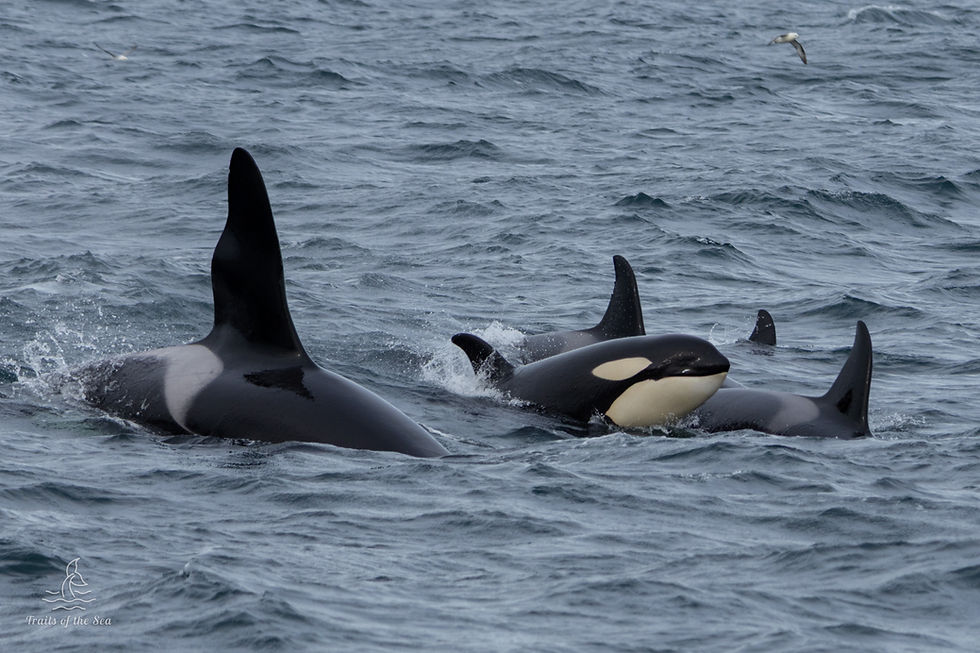
The world’s second-largest animal, after the blue whale. Fin whales can grow up to an incredible 27 m. However, there is a size difference between fin whales from the Northern Hemisphere and the Southern Hemisphere. In the Northern Hemisphere, the largest fin whales reach up to 24m in length, whereas in the Southern Hemisphere they can reach up to 27m. In both populations, females are larger than the males; this is the case with all baleen whale species. And to see them in the wild next to the boat, it's just incredible; it takes a few seconds before the fin whale has completed its surfacing sequence. where with species such as orca and white-beaked dolphins, a surfacing sequence is 1 or 2 seconds, but with the fin, it can be up to 10 seconds!

Their average weight is around 90tons. To put this into perspective, 90 tons is roughly the weight of 18-20 African elephants! Even though they are absolutely massive animals, they still look very slim because they are extremely streamlined. They are so streamlined that they move very gracefully through the sea, without hardly any effort, it seems. They don’t need to lift their fluke out of the water to go for a deeper dive like other whales. They simply arch their back a little bit and disappear into the blue. Their streamlined-ness also makes them very fast whales; they even have the nickname ‘greyhounds of the sea’, as with a simple flick of their tail, they can reach speeds of almost 40km/h. On average, they swim between 5 and 15 km/h. Their speed can make it tricky at times to watch them from a whale-watching boat, as it can be hard to catch up. This season, we know they have been in the fjord for more days than we have actually seen them. The blow of a fin whale is a giveaway as it is a straight column of air which can reach up to 8 or even 10 meters tall.

They are very beautiful animals, not just because they are large and graceful, but also because of their colouration and patterns. Actually, some of the patterns on the fin whale are asymmetrical. The lower jaw of the fin whale is dark on the left side and white on the right side. The other day, when we had some really close looks at these fin whales, we could clearly see the bright white lower jaw. Across their back, just behind their head, they have a light grey/white pattern called a chevron, which is lighter on the right side of their body. The reason why the patterns on the right side of the body are lighter is still a mystery.
Distribution
Fin whales have a worldwide distribution, from Antarctica to the Arctic. But with distinct populations in the Northern and Southern hemispheres. These two populations never meet. I have been lucky enough to see them in both parts of the world. In 2022, I saw my first fin whale in Scotland; later that year, I got to see many fin whales together feasting on krill in Antarctica; and in 2023, I saw them feasting off the coast of Greenland.

The Arctic and Antarctic are the feeding grounds of the fin whales. Fin whales, like many baleen whales, are mostly migratory animals. For mating, they travel to warmer waters; unlike some other whales, the exact locations of fin whales' breeding grounds are still unknown. They stay in the open ocean, which makes them difficult to track. Through a network of passive acoustic hydrophones in the Atlantic Ocean, a southward-moving pattern was observed during autumn. Giving evidence that during the autumn, fin whales seem to move from Canada all the way down to Bermuda and into the West Indies. But not all fin whales migrate; in a few regions, they seem to be resident and stay there year-round. These suspected resident regions are the Gulf of California, the Mediterranean Sea and the East China Sea.
Life of a fin whale.
In 2023, I was lucky to see a mother-calf pair of fin whales in the Azores. The gestation period of fin whales is 11 months, and once a calf is born, it will stay with its mother for 6 to 12 months. In this time, it will learn everything it needs to know before they go their separate ways. Fin whales have calves every 2 to 3 years. Further, very little is known about fin whales. It is believed that fin whales reach sexual maturity between the ages of 6 and 8 and can live 80 to 100 years.

Fin whales are usually found either on their own or in pairs. They live a quiet life; they hardly ever breach or spyhop. They just calmly surface for a breath of air and roll their long body through the water on their way down again. They aren't interested in boats, but they don't care about them either. So if a boat is respectful next to them, they will simply accept it and continue on their own way. They mostly feed on krill and small schooling fish such as capelin. The capelin is the reason they come into Breiðafjörður. A fin whale can eat up to 2 tons of food per day! They do this with their baleen plates: they take large gulps of water, filter it through their baleen plates, which hang from their upper jaws, and their food stays behind in their mouths.
Fin whale communication
Fin whales do use sound to communicate; their vocalisations are at very low frequencies. They range between 16 and 40 Hz. For us humans, 20Hz is the lowest range we can ‘’hear’’, although it would be felt more as vibrations than actually heard. What is really interesting about these vibrations is that they can be heard on seismometers on land! In a recent feasibility study, researchers tested whether these seismometers, deployed on coasts worldwide from Iceland to Antarctica, could detect fin whale vocalisations. And they can! That means that the fin whale vocalisation is so low that it has the possibility to shake the earth! This type of research can potentially help protect fin whales from threats such as ship strikes, entanglement in fishing gear and noise pollution. This system could serve as a warning system, notifying ships of whales' presence in a coastal region.

These gentle giants are simply amazing and truly gentle animals. During the whaling, fin whales were heavily whaled, almost to extinction. It is estimated that around 915,000 fin whales were taken during commercial whaling. Today, there are still quotas by Iceland and Japan for the continued whaling. Luckily, Iceland is unlikely to whale in the near future, as the practice is considered unprofitable. However, Japan does still hunt them. In 2025, the quota of 60 fin whales was fully taken. They are still classified as vulnerable by the IUCN Red List. Their numbers are slowly increasing; there are estimated to be around 150,000 fin whales swimming in our oceans. Since they don't come close to a coastline very often, seeing these animals in the wild is even more special.
Sources:
Carwardine, M. (2022). Field guide to whales, dolphins and porpoises. Bloomsbury Publishing.
Guazzo, R. A., Stevenson, D. L., Edell, M. K., Gagnon, G. J., & Helble, T. A. (2024). A decade of change and stability for fin whale song in the North Atlantic. Frontiers in Marine Science, 11. https://doi.org/10.3389/fmars.2024.1278068
Möllhoff, M., & Bean, C. J. (2025). Fin whale song recordings by onshore seismometers open new horizons for cetacean coastal monitoring. Scientific Reports, 15(1), 13475. https://doi.org/10.1038/s41598-025-97638-4
Notarbartolo‐di‐sciara, G., Zanardelli, M., Jahoda, M., Panigada, S., & Airoldi, S. (2003). The fin whaleBalaenoptera physalus(L. 1758) in the Mediterranean Sea. Mammal Review, 33(2), 105–150. https://doi.org/10.1046/j.1365-2907.2003.00005.x
Simon, M., Stafford, K. M., Beedholm, K., Lee, C. M., & Madsen, P. T. (2010). Singing behavior of fin whales in the Davis Strait with implications for mating, migration and foraging. The Journal of the Acoustical Society of America, 128(5), 3200–3210. https://doi.org/10.1121/1.3495946
Knowlton, C. (2021, November 5). Fin Whale. Discovery of Sound in the Sea. https://dosits.org/galleries/audio-gallery/marine-mammals/baleen-whales/fin-whale/
Whale and Dolphin Conservation. (2023, November 15). Fin whale - Whale and Dolphin Conservation. https://uk.whales.org/whales-dolphins/species-guide/fin-whale/
NOAA (2026). Fin Whale. https://www.fisheries.noaa.gov/species/fin-whale
International Whaling Commission. (n.d.). Fin Whale. International Whaling Commission. Retrieved April 12, 2026, from https://iwc.int/about-whales/whale-species/fin-whale


Comments