
Season 2: Back in Iceland!

Three and a half months! How have three and a half months passed already? Over the past few months, I have worked on more than 100 whale-watching trips. And this year is definitely different from last year. For one, the weather is different; it has been colder, with more snow and more storms. Second, at times, the whales have been difficult to find. We haven’t been able to see whales on every trip; we are, of course, dealing with nature, and no wildlife-watching trip can ever guarantee any sightings. During the first few weeks, we expected more feeding frenzies than we actually saw. However, this did make the feeding frenzies we did get to see even more amazing! Some trips have been beyond expectations and absolutely mindblowing, leaving everyone without words to describe what just happened.

It has been amazing to be back here in Grundarfjörður. In February, I was loving the winter weather; the temperatures hardly rose above freezing, and every now and then the world got a fresh new dusting of snow. At that time, the sun sets fairly early. In my first two weeks, the sunset was between 17:45 and 18:30. This means that it is dark enough early in the evening to go out on an aurora hunt. This February, I have been so lucky with some absolutely stunning aurora shows. And that just quite often during an after-dinner walk, oh, the luxury of not needing to stay up until the middle of the night. Sometimes the sky really lit up in many colours, dancing through the darkness between the stars. On those nights, I could easily be outside for an hour without feeling the piercing coldness of the Icelandic winter weather. It’s amazing how one can be so overwhelmed by nature's beauty that one stops feeling certain unpleasantness, such as a freezing-cold wind.

This year I am living in a different place, and this time my bedroom window has a view over Kirkjufell, which definitely feels surreal at times! I am closer to the sea, and I love watching the view from my window. In February and March, the snow buntings would be just outside my window, fluttering between the trees across the road. Now that summer is coming, they have travelled farther north to their breeding grounds in the Arctic.
Storms in Iceland

The whales in February were great, too. On our first day back out to sea, we had three trips, and each was fantastic, with feeding frenzies of orcas and humpback whales, and we also saw white-beaked dolphins! What a warm welcome back to Breiðafjörður. And then the first of many storms hit, and we couldn’t go out to sea for 2 days. This would be a common occurrence in the next month and a half or so. Work for a day or two, then storm; work a few days, then storm, and on and on it went until April. In March, we only had tours for half the month due to bad weather. But whenever we did go out, we managed to see orcas and humpback whales on most trips. And in the middle of March, we were surprised by multiple fin whales in the fjord! There must have been at least six. It’s in the spring that we have the biggest chance of seeing this, the second-largest animal on the planet. Almost every year during the spring, fin whales come to Breiðafjörður. After those two days, we didn’t see them again.
Having many storms meant we had plenty of days off, which might be good for rest and writing; however, the weather often prevented us from going outside to take walks and (re)explore our surroundings. Instead, we went to the gym, something I didn’t do last year. And I started to learn Icelandic, which, quite frankly, is a very slow process for me. All these storms did mean that at some time, I was absolutely done with the winter weather. I have now experienced some proper snowstorms/blizzards; they may look cool through the window, but you can't do that much. All that weather is also the reason I managed to read 6 books in March. At the end of March, a former colleague, Chrissy, came and visited me for a few days. She came with us on a few tours in the hope of seeing orcas, but the weather was being very Icelandic, trying to find whales in the middle of a snow shower is pretty damn difficult. After two trips with no sightings at all, it was time for a third and final trip before she had to return to Reykjavik. Luckily, the saying three times the charm still works! We managed to get some fantastic looks of orcas in the snow! It was amazing to have someone visit and see my new home with a fresh set of eyes.

All the stormy days mean that there is more motion in the ocean. which means choppier trips, which, for some guests, isn't ideal. The whales, on the other hand, are even more impressive. especially the orcas in the waves, they really need to lift their heads out of the water to take a breath of air, and they swim more in a small, jumping kind of way. It allows us to really see the power of their bodies.
Arrival of spring

March turned to April, and with it came some good weather (finally). We went out almost every day; some days were more difficult to find any whales than others. But early April, a few more fin whales appeared in the fjord, and some came incredibly close to the boat, seemingly unbothered by our presence. Seeing these majestic animals so close to the boat is definitely one of the highlights of this season. We simply drifted next to them. And could clearly see how big they are! Almost the same size as our 24m boat! In April, the sperm whales and minke whales arrived in the fjord! We saw the first sperm whales in early April. They will always be so impressive to see with their giant bodies and big tails, which they lift high out of the water to dive to the depths of the fjord. We only have the male sperm whales here, as females stay in the warmer waters. The males can grow up to an impressive 18meters. Minke whales arrived around mid-April, and with them came the welcoming signs of spring. There is a belief here amongst the whale watchers that when the minke whales return, spring has well and truly arrived! It really felt like it; the temperatures rose to above freezing. After two cold months, even temperatures of 5 degrees Celsius suddenly felt absolutely balmy.

With the arrival of spring, it's not just the whales that return from their migrations; seabirds such as the puffin also come back. I actually saw my first puffin of the season on the 2nd of April, which seemed very early, as most don’t come back until the middle of April. What might surprise some of you is that April also contains the first day of the official summer here in Iceland. Officially, Iceland only knows two seasons: summer and winter. Summer starts on the first Thursday after the 18th of April and ends on the last Saturday of October. This year, summer started on the 23rd of April. Not sure, though, whether the weather actually got the memo. Something with wintery weather in early May, even with snow!
The first of May was another day with sightings that are going straight on the highlights list: orcas in a feeding frenzy, with northern gannets plunging into the sea. Nothing too special about that, except it's always amazing to see a feeding frenzy like this. But what made this feeding frenzy additionally special was the fact that this feeding frenzy also included humpback whales and white-beaked dolphins! Orcas feeding together with humpbacks and white-beaked dolphins. Just mind blown! We didn’t know where to look; so much was happening at the same time. There, a humpback is coming out of the water with its mouth full of herring, over here, a young orca is playing with the dolphins, and there, gannets are diving while orcas come up between them. Oh, and now orcas and dolphins are swimming side to side, passing a humpback whale. Everyone on board was in absolute awe of the wildlife's beauty. It honestly felt like we were witnessing a nature documentary live!
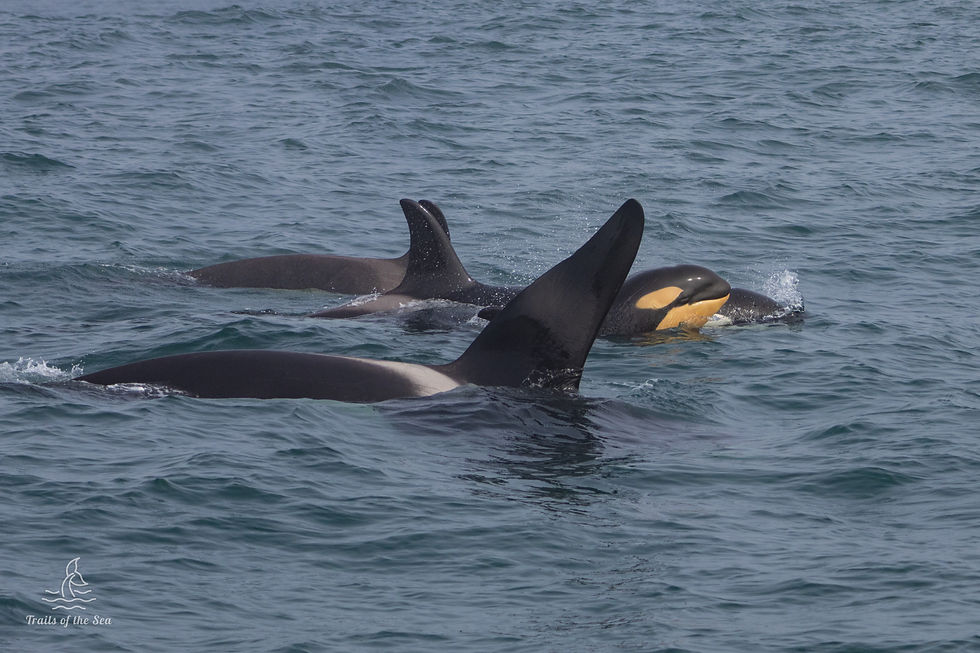
What has also been amazing until now is the number of tiny orca calves we have seen! There have been groups with orcas with calves less than a few weeks old. which would melt anyone's heart. Plenty of these orcas have also been very social, displaying many social behaviours such as playing, spyhopping and even some breaching. We had a few occasions when humpback whales were lunge-feeding, which is also an impressive sight.
Exploring the south coast of Snaefellsnes.
The following next few days, I forgo my usual guiding role and become a spotter, as our usual spotter is on holiday. Armed with my camera and many layers (of course, winter decided to show its face one last time), I climb to the top deck and start my few days of spotting and collecting photo-identification data on orcas and sperm whales (I will dedicate a future blog post to photo-identification research). These days, we also have some special passengers on board, aka my parents, which doesn’t bode well for us, as they aren’t the luckiest when it comes to wildlife spotting. On their first trip, we saw some sperm whales; on their second trip, lots of seabirds but no whales or dolphins at all. But they still enjoyed the sailing. And that is the best way to join a whale watching trip, just enjoy the ride! Enjoy the landscapes, enjoy the many seabirds that are around, try to spot a puffin, and look at the soaring fulmars flying with the boat.

Whilst they were here, I had one day off, and we used this to drive to the south coast of Snaefellsnes, visit Ytri tunga beach, and the lava fields around Búðir. But before we left, we first got a coffee at Valeria in Grundarfjordur. I don't drink coffee that often, but at Valeria, I would say they definitely have great home-roasted Colombian coffee. Well fueled up, we headed south of the peninsula to Ytri Tunga Beach, which is well known for its seal colony. During the low tide, we may see many harbour seals and the occasional grey seals resting on the rocks in front of the beach. Always keep your distance from wildlife! They might look cute, but they can bite. On our way to Búðir, we stopped in a small forest for a small 1km walk. And then at Bjarnafoss, to look at a stunning waterfall.

In Búðir, there is an often-photographed black church, but next to the church, there is a beautiful lava field, Budahraun. This lava field is estimated to be around 8000 years old! You can do a 7km walk through the field. We only did a short part of the walk because we got there quite late and had a dinner reservation. It was great to see my parents again, but time passed very quickly, and before we knew it, it was time for them to leave again. And of course, the day they leave, we see lots of orca in a feeding frenzy!
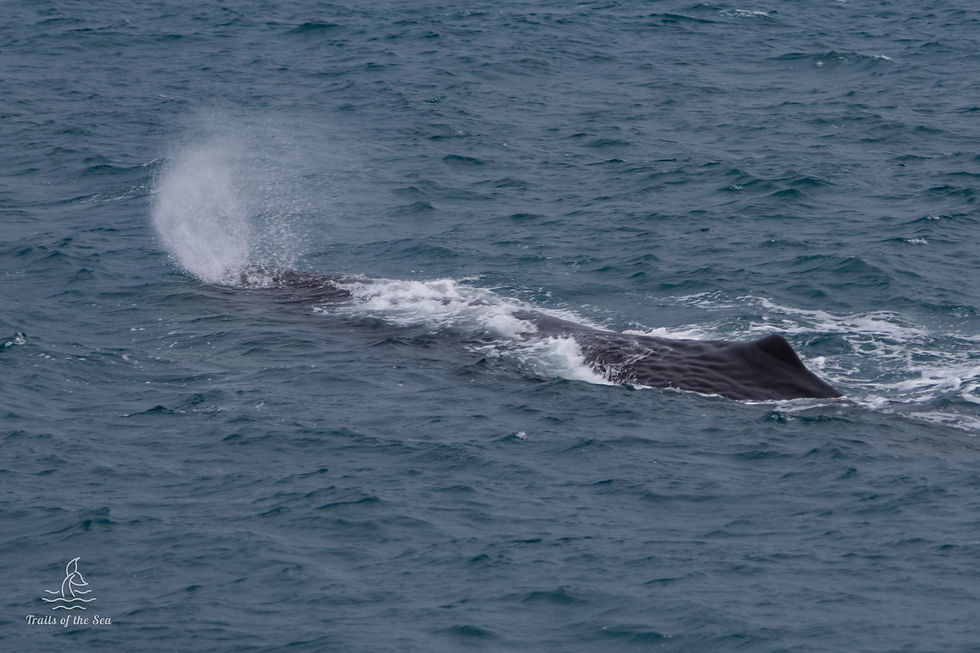
Until now, in May, our most frequently seen species is the sperm whale. One day last week, one sperm whale tried to steal the show and became one of my best whale encounters ever! We were watching two sperm whales resting side by side at the surface. We were approximately 100m away from the two males and turned off our engines. The first whale lifted it's fluke and dove to the depths of the fjord, we all waited in anticipation for the second whale to also lift its fluke. However, he didn't. He started swimming away from us at first, then turned around and came towards us until he was right next to us (see video on my Instagram)! If I had stretched out my hand, I would have been able to touch the fluke when he dove down on a shallow dive. Everyone was absolutely flabbergasted and left without a word, with huge smiles on our faces and some with tears in their eyes. This is one of those rare moments that hardly ever happen, a whale being curious about us humans on this boat. How amazing wildlife can be! Of course, not every trip has
special encounters like this. But any day spent seeing a whale or dolphin in the wild and free, as they should be, is a great day!
Throughout these first three and a half months, one thing has been very consistent: our most frequently asked question on the boat. Earlier this season, there was a time when not a single trip went by without a question about the blue whale. For some reason, this year, many guests are interested in blue whales. Is it possible to see them here? Are they rare? And so on. I wonder where this fascination with the largest animal on our planet comes from? Even now, not a week passes without a member of the crew hearing a question about the blue whale.

Another difference this year, compared to last year, is that since April, we have had enough guides to take the occasional day off. And that means, especially now in the middle of May, whilst spring is really happening, with the first signs of summer in the air, there is more time to explore. Like the other day, when I finally managed to go to a waterfall just outside of town called Kvernafoss, and this waterfall is gorgeous! Moments like this are much needed. On all the days I work, I notice that I sometimes forget to truly look around me; it almost feels like I take this place for granted. That is why it is so important to at least once or twice per week, really go outside in nature alone without any modern distractions, like going to a waterfall or watching the sunset around 23:14, to really appreciate where I am and how lucky I am to call this island home for a few months of the year. Summer is definitely on its way, the temperatures during the day have reached 10+ degrees Celsius, on some days in the sun, even 15! This might sound more like spring for most people, but here in Iceland, this is incredibly warm, you know, shorts kinda weather!
I am really curious what else this second season in Iceland has in store for me. What other wildlife encounters are waiting for us?

Comments