
How your whale photos can contribute to whale science!


Most people who go out on whale-watching trips these days instantly grab their phones and cameras the moment a whale or dolphin sighting has been announced. Sometimes we even see people who immediately start filming, even though we say it's still very far, but you can train your whale-watching eyes. We say this because keen-eyed guests sometimes start pointing already; this normally means we probably have to sail for a few more minutes to actually reach the animals. But once we are with the animals, people are often so glued to their cameras that they miss the magical feeling of seeing whales and dolphins in the wild. I sometimes overhear people asking each other, "Did you capture that?" rather than "Did you see that?" Which leaves one to wonder: did they actually see the animals with their own eyes? This has gotten so bad at times that we are now reminding people to also look with their own eyes and really lock in the memory of seeing whales and dolphins in the wild.
I used to be the same, especially at the beginning of this career, but the busier you are taking photos, the less you actually see what is happening in front of you. This season I have been taking fewer photos and being more in the moment, and you get so much more enjoyment from the encounters than from always wanting to capture what you are seeing, as if without the photos or videos you can’t prove that you really saw that whale. I would actually now suggest just taking a few photos or videos at the beginning, then putting the phone or camera away after a few moments and really enjoying the sighting! However, I haven’t fully stopped taking photos. When I do take photos now, I focus more on something more specific, like flukes (tails) and dorsal fins. These kinds of photos can actually help and contribute to science. And what is great is that anyone can do this, and anyone can help collect this type of data, especially for species such as humpback and sperm whales. This research method is called photo-identification.
Why is photo-identification really important?

This type of research gives us a better understanding of how many individuals there are. How old can whales get? Where do they travel to? How often do females get calves? And for some species, it can also tell us a lot about their social structure. However, it can also tell us more about what these whales experience over their lifetimes. Sometimes whales are seen with new scars. With some scars, we can’t tell what caused them; with others, it is very clear, like a humpback whale with markings from a propeller; in other words, it has been hit by a ship. Or some whales get entangled in fishing gear, and then you see clear scar lines on their bodies.
But how does this photo-identification work?
Most whale species have something that makes them unique from other individuals. Just like we humans have different fingerprints. These whale fingerprints can be very useful for research; of course, whales don’t have fingers, but they do have flukes and dorsal fins, and these are basically the whales' equivalent of a fingerprint. Whether the fluke or the dorsal is used varies by species, and for some species the differences are more obvious than in others. A species where this ‘’fingerprint’’ is very obvious is the humpback whale.
Humpback whale photo-identification.
The fluke of a humpback whale is truly unique per individual; it’s the shape and the colouration on the underside of the fluke that make it easy to identify them. Some flukes are completely black, whereas others are completely white; some have brown markings, and they can have various different patterns in these colours. But its not just the colouration, its also the shape of the flukes and the scarring that they can have. And humpback whales tend to lift their fluke into the sky before going on a deeper dive, which gives scientists and photographers a good view of the underside of the fluke. By taking photos like this, researchers have been able to learn more about the migration patterns of humpback whales. Humpback whales travel great distances during their migrations between their feeding grounds and breeding grounds. Feeding grounds tend to be in the colder waters; the breeding grounds tend to be in the warmer tropical waters. Photoidentification research has shown that humpback whales seen in Iceland have migrated to the Caribbean and to the west coast of Africa, like Cape Verde.
Humpback fluke Humpback fluke Humpback fluke Humpback fluke
Sperm whale photo-identification:
But it’s not just with humpback whales whose fluke photos can help identify specific individuals; it also works with species such as sperm whales. However, for sperm whales, it's not always that obvious, as they don’t have different colourations on the fluke. With sperm whales, the focus is more on the shape of the fluke, and the scarring an individual might have. Sperm whales, too, can be found in both warmer waters and colder waters. Here, however, it’s only the males that migrate. Females stay in the warmer tropical waters, where the males are the ones who migrate. Therefore, photo-identification research is very important for understanding more about the migration patterns of male sperm whales. In recent years, we at Láki Tours have begun collecting ID photos of the male sperm whales we see, as our colleague Nolwenn is working on a catalogue. The aim of this research is to collaborate with other researchers to better understand the movement patterns of these male sperm whales.
But photo-identification studies can also help gain a better understanding of the social structures of whales; this is especially true for female sperm whale populations. Female sperm whales are very social animals and form matriarchies; family members tend to stay together, as shown by research such as photo-identification.
Sperm whale fluke Sperm whale fluke Sperm whale fluke Sperm whale fluke
Orca photo-identification
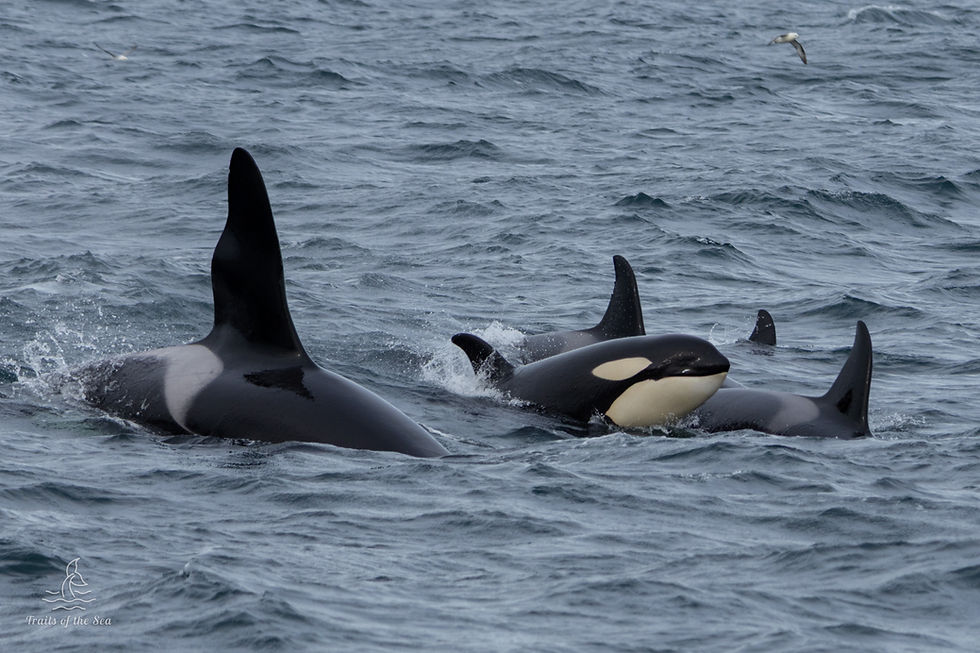
This social-structure research using photo-identification is common with orcas. This first started in the 70s in Canada, and now it happens worldwide, including here in Iceland. And actually, we do research on the orcas in Breiðafjörður through my colleague Marie; she set up her own non-profit organisation called Orca Guardians. The aim of the research is to learn more about how many orcas there are in this region and what the family connections are. Photo-identification of orcas doesn’t focus on the flukes of the orca, but rather on the dorsal fin and the saddle patch (the white/grey patch behind the dorsal fin). The dorsal fin shape varies by individual, and the patterns on the saddle patch also vary. Then there is the scarring and nicks they can have, which can sometimes make it very easy to distinguish one from another.
Marie has been doing this research since 2014, and since then she has identified well over 1000 individuals. While some come back every year, others come only once or every few years. Our main orca season runs from February to June. Quite often, we see the same matrilines at roughly the same time of year, which also means that we know some matrilines really well. But there is more to the research Marie does: because she focuses on this region, she also studies their behaviours and how individuals interact with one another and with other species, such as white-beaked dolphins and humpback whales. If you want to read about how the photo-identification research started in Canada in the 70s, I highly recommend the book: Orca: The Whale Called Killer by Erich Hoyt.
Orca dorsal and saddle patch Orca dorsal and saddle patch (Sakkara recognisable by her nick in ) Orca dorsal and saddle patch (Boromir) Orca dorsal and saddle patch
How you can contribute
For some species, anyone can contribute to photo-identification research, such as humpback and sperm whales. There is a citizen science website called Happy Whale. Anyone can upload photos of whales they have seen and contribute to science. It’s possible to upload photos taken from whale-watching tours, but also from whales you have seen from land. Just any whale photo that shows something unique to that individual, like the flukes and dorsal fin, can greatly help. And what is amazing is that whenever you upload a whale photo, you will get updates on who the individual is, and whenever the individual has been seen again, you will receive updates. In other words, you get to follow the whale you have seen. This citizen science website started out for humpback whales; however, it now also accepts photos of other species, such as sperm whales, orcas, pilot whales, and many more.
You can also contribute by donating money to researchers, such as Marie’s Orca Guardians. On orcaguardians.org, you can adopt an orca. With this adoption, you will make a one-time donation that will help support the continuation of Marie’s research. For more information on the Icelandic orca population, see the following page: Photo ID catalogue Orca Guardians.
Through this research, there have been orca matches between Iceland and Scotland and Iceland and Norway! This type of research is very rewarding to learn more about different populations of whales and dolphins.
So taking photos and filming whales and dolphins can be very important, and you can also share your photos on Happywhale and contribute them to science, so we can learn even more about these amazing animals. But don’t forget to also enjoy seeing these animals in the wild and free, as they should be!
Sources:
Basran, C., Chosson, V., Williams, A., Simpson, N., Long, S. A., Dodds, F., Rasmussen, M. H., & Horrocks, J. A. (2023). Short Communication: First documented migration of an Icelandic humpback whale mother and calf pair from the West Indies breeding grounds. the Journal of Cetacean Research and Management. Special Issue, 24(1). https://doi.org/10.47536/jcrm.v24i1.833
Fuller, S., Maggi, S., Mussi, B., Kypraios, T., & Pound, M. P. (2025). Whale Vision: A tool for identifying sperm whales and other cetaceans by their flank or fluke. Ecological Informatics, 91, 103384. https://doi.org/10.1016/j.ecoinf.2025.103384
Hoyt, E. (2019). Orca: The Whale Called Killer.
Wenzel, F. W., Jann, B., Allen, J., Carrillo, M., Hanquet, S., Katona, S. K., Martin, A. R., Reeves, R. R., Seton, R., & Stevick, P. T. (2023). Migration of a humpback whale (Megaptera novaeangliae) between the Cape Verde Islands and Iceland. the Journal of Cetacean Research and Management. Special Issue, 5(2), 125–129. https://doi.org/10.47536/jcrm.v5i2.812

Comments