
Norwegian winter: whales & snow.

It had always been a wish of mine to go to northern Scandinavia in the winter. Specifically to Norway. The main reason: orcas! In winter, herring migrate into the Norwegian fjords, attracting many whales. From late October to mid-January, orcas, humpback whales, and fin whales, among others, can be found in the waters of Arctic Norway, where they come to feed on herring. It’s one of the best places in Europe to see orcas in the wild. And the image this paints sounds absolutely magical: only a few hours of daylight, snow-covered mountains, and whales swimming everywhere. No wonder this also attracts many tourists, who want to see this spectacle for themselves. This results in many whale-watching boats in the area. There are also many fishing boats in the same fjords, fishing for the same fish as the whales: herring. These fjords are therefore very busy. Is it too busy? Or is it okay? I definitely want to find out and see these orcas and the incredible scenery for myself.
Norwegian winter 2024
Before I got a job as a whale watching guide in Iceland, I had always wanted to see an orca in the wild. In the three years I worked on cruise ships, I had seen an orca only once, and that encounter lasted only 2 seconds. So I was thrilled when, in October 2024, I received an offer to join a cruise to winter Norway. I thought I would finally see an orca up close in the wild. November came around, and I boarded Fred. Olsen’s Balmoral for a little over a week to sail to Norway. Oh boy, what a cruise it would be, for mostly the wrong reasons. I know now this would be my final cruise as an Ocean Conservationist, and it was probably one of the worst experiences I've had. The scenery of Norway and the guests had nothing to do with it. The weather, however, played a large part in the bad experience: we were, at some point, literally stuck inside Altafjord for an entire day because hurricane-force winds just outside the fjord prevented us from leaving. This set off a domino effect, with two ports cancelled. During the same trip, my fellow OCs and I learned we would be gradually phased out as OCs.

All in all, there were plenty of things happening that gave me a cruise I look back to with mixed feelings. Throughout the cruise, we saw hardly any whales or other wildlife during our surveys. However, I did see two orcas from the ship after sunset. The sunset was around 13:00. Two males swam past the boat and on into the darkness. During our stop in Alta, we did go on a whale-watching trip and saw around 40 humpback whales and a very distant orca fin. This entire cruise left me with the feeling as if I had only glimpsed what Norway in the winter could offer. When I came home, I told my parents I really, really needed to go back and try again. I was desperate to see orcas properly in the wild, I wanted to see a feeding frenzy, maybe a spy-hop, just anything other than the distant tall fin. My parents were easily convinced, and so we started planning to travel up to Norway in a year. Little did I know that only three months after the cruise, I would already get my orca fill for 2025, as I landed a job as a whale-watching guide in Iceland. In arguably the actual best place in Europe to see Orca, Ólafsvík, Snæfellsnes. Now that a year has passed, we are already back from a fantastic trip to Tromsø and Skjervøy, Norway. We definitely got what I had wished for from the trip: orcas with some amazing behaviours. But we also got plenty of snow.
Tromsø and the first whale-watching trip
We planned our trip to be in Norway for seven whole days, starting in Tromsø for a few nights. Tromsø is a lovely, small city above the Arctic Circle. It's situated on the island of Tromsøya, nestled between mountains on either side of the Tromsøysundet strait. On the first day, we had a relaxing day, walking through the city and visiting two museums: the Polar Museum and the Troll Museum. Two completely different museums, one very informative about the history of Arctic exploration, and one about Norwegian Myths.

On our second day, we woke up really early to board a whale-watching trip from Tromsø. We went with the electric boats of the company Brim Explorer. This meant the tour would fill an entire day, as these boats can't travel as fast as other whale-watching boats. It took us about 4 hours to reach the region (Skervøya) where the whales are. We left Tromsø whilst it was still dark. Throughout the first hours, we slowly saw light emerge, first turning the world around us blue, then pink/orange, before the clouds entirely took over the sky. It was beautiful to see the winter landscape, with snow-covered mountains appearing from the darkness. At some point between the clouds, the waning moon showed itself. We enjoyed the calm boat ride, with the occasional short talks by the guides about the region and whales. During the journey towards the area, we got overtaken by plenty of other whale-watching boats. When we reached the waters around Skervøya, we basically had an hour to find some whales and see them. We were lucky, though, that the sun made another appearance before it set. It took quite some time before we found some whales. We did manage to see a humpback whale (Megaptera novaeangliae), which swam past the boat, did one fluke slap and then disappeared. Then, several tall black fins were seen not far away, and an approach was made towards the orcas (Orcinus orca), but at least two other boats also approached the same group; they were faster and drew closer to the animals.

This is where I start to struggle with whale-watching, with multiple boats and companies involved. Whale-watching, or any wildlife watching, must be done responsibly, especially for the animals. We want to see these animals in their natural habitat, undisturbed. For whale watching, there are responsible whale-watching regulations; these tend to vary by country and are often voluntary. However, the basics of these regulations tend to be the same across countries. You can't ever approach a whale head-on or straight from behind, only on the side. Within 300m, you have to slow down, and within 100/50m, stop the engines. Quite often, there is also a limit on how long you can stay with the same group or individuals. This time spent really varies by country: for some, it's 10 minutes; for others, 20 or even 30 minutes. These times do depend on how many other boats are around the same animals.

The more boats, the less time can be spent; if you are the only boat, more time can be spent with the animals. Always check before you book your whale-watching experience whether the website at least mentions the responsible guidelines, or preferably shows them in an illustration. Then you know you are booking with a responsible whale-watching company.

But how do the whales react to the boats? Well, in Norway, especially the orcas, are quite accustomed to boats. They have even been seen attracted to fishing boats, trying to take advantage of the herring being caught in the nets. However, there is a difference between whales being attracted to boats and vessels approaching them. It is always possible that the animals come very close to a boat, but this must happen on their own terms. Then the captain needs to respond correctly, like turning off the engine and making no sudden movements that might harm the whales.
In the end, the orcas swam away from the other boats, and initially seemed to leave the boats altogether, until they turned around and swam right behind our boat and past us closely before they disappeared, and it was time again to head back towards Tromsø. By the time we left the area, the clouds had gathered again, and it began to snow; the sun had already set, so darkness enveloped us soon after. The way back was very uneventful, except for 10 minutes when the sky cleared enough for the Northern Lights to shine through. Once we got back to Tromso, we got some dinner and went back to our hotel. The next day would be a long day.
Skjervøy and the whales.
The next day, we picked up a rental car and drove out of Tromsø towards Skjervøy. The town/ island is the current whale watching hot spot in the Norwegian winter. From Tromsø to Skjervøy, it's roughly a 3-hour drive, depending on the road and weather. We had some snowy conditions, but the roads were doable. If you really want to reach Skjervoy, you don't have to drive yourself; there is a bus and a ferry. However, the ferry does not run very often, and the return trip to Tromsø is usually late in the evening, which is why we chose the car. It was a beautiful drive through mountains, past fjords, through tunnels and over bridges.

We arrived after sunset on Skjervøy, checked into our apartment, enjoyed a relaxing evening, and woke up in the middle of the night to see the Northern Lights a few times. The first time we got out of bed, we saw some green aurora dancing overhead; the second time, the sky turned bright red! I hadn't previously seen any bright red aurora before. The next day, we went on another whale watching trip. This time we didn't have to wake up too early, we walked to the harbour and boarded our small boat with Skuanature. There are several whale-watching companies in Skjervøy; both Skuanature and Dervola come highly recommended. It was a small boat with a warm interior, room for 12 guests. We left the harbour, and within 20 minutes we spotted our first group of orcas. At the time, we were still in a place with many boats. We spent a few minutes with this group until more boats showed up. Our captain and guide decided it was better to leave, so we moved on and went deeper into the fjord. The plus side is that we got slightly calmer waters and a quieter scene, with fewer boats. There were also plenty of whales swimming in the fjords.

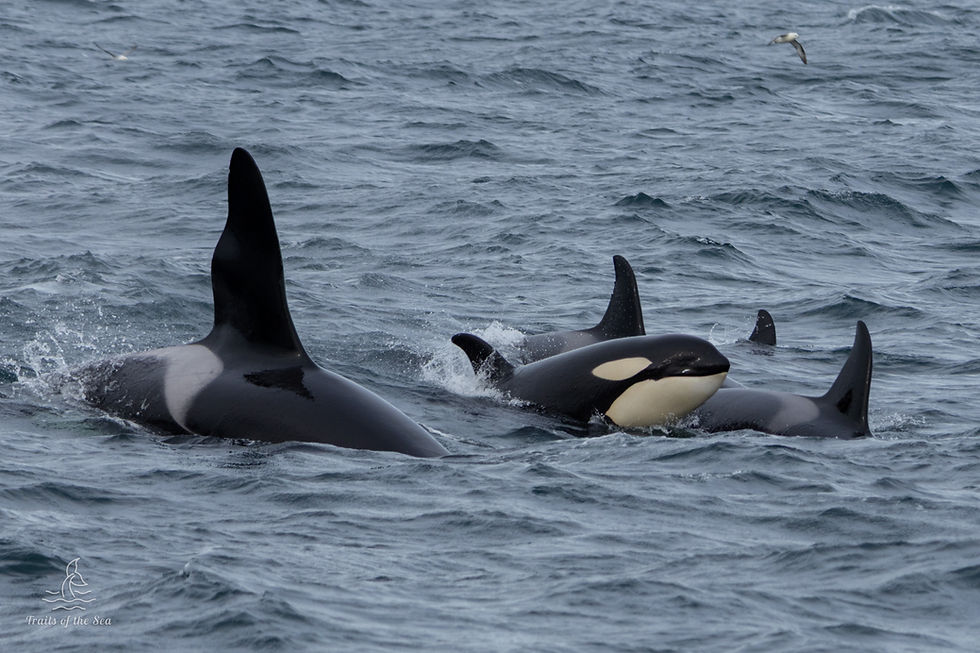
We ended up seeing more orcas and humpback whales, and, as an added surprise, some fin whales! For the vast majority of the rest of the trip, we were alone with the whales. We saw other tour and fishing boats in the distance, but we hardly shared the whales with them, and when we did, we soon left. We had some amazing encounters, but the best happened on our way back to the harbour. We noticed some gulls started circling in one spot, and both the captain and the guide decided we should check it out. They took the boat to a position neither too close nor too far from the birds and waited. And oh boy, was it worth the wait! Suddenly, multiple orcas broke the surface, obviously feasting on herring. A feeding frenzy is one of the best ways to see these animals; it feels as if you are in a nature documentary, with whales coming up all around you. You can clearly tell they are working together to herd the fish into a tight ball to the surface. We were also lucky to see one orca spyhop, something my dad really wanted to see. A spyhop is a behaviour in which a whale raises its head above the water to observe its surroundings.

We stayed with the feeding frenzy for some time, until it was really time to head back to the harbour, as some guests had a bus to catch to Tromsø. Once we were back, we walked around Skjervøy, bought some much-needed spikes for our shoes, since the town was basically an ice-skating rink. The next day, the wind was too strong, so we enjoyed a beautiful snow hike across the island, as it had been snowing all night.
Why Skjervøy?
As mentioned earlier, the whales come to the waters around Skjervøy for the herring. The Norwegian herring is considered to be the largest fish stock in the North Atlantic. In the 1960s, this stock collapsed due to overfishing. It took the herring almost 20 years to recover. Herring naturally migrate from the spring spawning grounds off the coast of Norway to their feeding grounds, a vast area that extends from Norway to Iceland and Svalbard, and finally to their overwintering grounds in the Norwegian fjords.

Throughout the last 50 years, there have been changes in the herring's overwintering grounds locations. In the 80s, the overwintering grounds were just south of the Lofoten (Ofotfjord and Tysfjord). Slowly, they have been moving further north. For some years, the herring was just off the coast of Tromsø. And now they are over 100km north of Tromso; the exact reason for this change remains unclear. There are theories that it has to do with warming seas, which shift the availability of their favourite prey (zooplankton) further northwards. Another theory is that, with the collapse in the 60s, their migrational memory was lost as many older individuals disappeared. Whatever the reason, the shift is likely to continue, meaning the whales will follow the overwintering herring farther north. Maybe in a few years, Alta might be the new place for whale-watching. From Alta, you can already book whale-watching trips and have a chance to see orca and humpback whales feeding on herring.
Back to Tromsø for lots of snow!

The day after our hike around Skjervøy, it was time to head back to Tromsø. We spent another day in the car driving through a semi-snowstorm; at times, the road was hardly visible. We made it safely back to Tromsø, and the next day we enjoyed a final day in a very white Tromsø, taking the cablecar up to the mountain, Fjellheisen. When we got to the top of the mountain, it was still cloudy. We walked a bit through the snow, and I decided the snow was deep enough to make a snow angel. My parents followed suit. Once we were done with the snowangels, the clouds had almost entirely disappeared, and we could see the city below us, all its lights. I definitely recommend going to the top of Fjellheisen when it's dark and the sky is clear. We didn't see the northern lights whilst on top of Fjellheisen; however, I can imagine it looking amazing, seeing the lights dancing above the city! The cable car runs quite frequently and all the way until late at night. A reason to come back at some point in the future.
If you want a magical winter experience in Norway with whales and snow, I definitely recommend a similar trip. Yes, many whale-watching boats are operating in the same area; however, if you book a trip from Skjervøy, there are some smaller companies that can go farther than those from Tromsø and may offer a more intimate, close encounter. But be very mindful of which companies to go with. They need to know the responsible whale-watching regulations. This applies to any place in the world where you want to go whale-watching; always check the regulations. And always remember: on a whale-watching trip, you are dealing with wildlife; no two trips are the same, and sightings can't always be guaranteed.
Artwork in Tromso Northernlights monument Tromso Moon on the way to Skjervoy A group of orca Orca Orca Male orca Humpback and orca Orca View from Skjervoy A frozen lake on Skjervoy Snow in Tromso
Sources:
Elin H. Sissener, Trond Bjørndal, Climate change and the migratory pattern for Norwegian spring-spawning herring—implications for management, Marine Policy, Volume 29, Issue 4,
2005, Pages 299-309, ISSN 0308-597X, https://doi.org/10.1016/j.marpol.2004.04.002.
Huse, Geir & Fernö, Anders & Holst, Jens. (2010). Establishment of new wintering areas in herring co-occur with peaks in recruit to repeat spawner ratio. Marine Ecology-progress Series - MAR ECOL-PROGR SER. 409. 189-198. 10.3354/meps08620.
Mul, Evert & Blanchet, Marie-Anne & Mcclintock, Brett & Grecian, W. & Biuw, Martin & Rikardsen, A. (2020). Killer whales are attracted to herring fishing vessels. Marine Ecology Progress Series. 652. 10.3354/meps13481. Rögnvaldur Hannesson, Stock crash and recovery: The Norwegian spring spawning herring,
Economic Analysis and Policy, Volume 74, 2022, Pages 45-58, ISSN 0313-5926, https://doi.org/10.1016/j.eap.2022.01.007.
Noway whale-watching regulations https://www.norwhale.org/en


Comments